Launch offer — valid today only

📄 Digital book in PDF · read it on your phone or print it

Boiler Operator License Exam, Illustrated Page by Page Read the Water Column, Test the Cutoff and Start Up Cold, Always in the Same Order

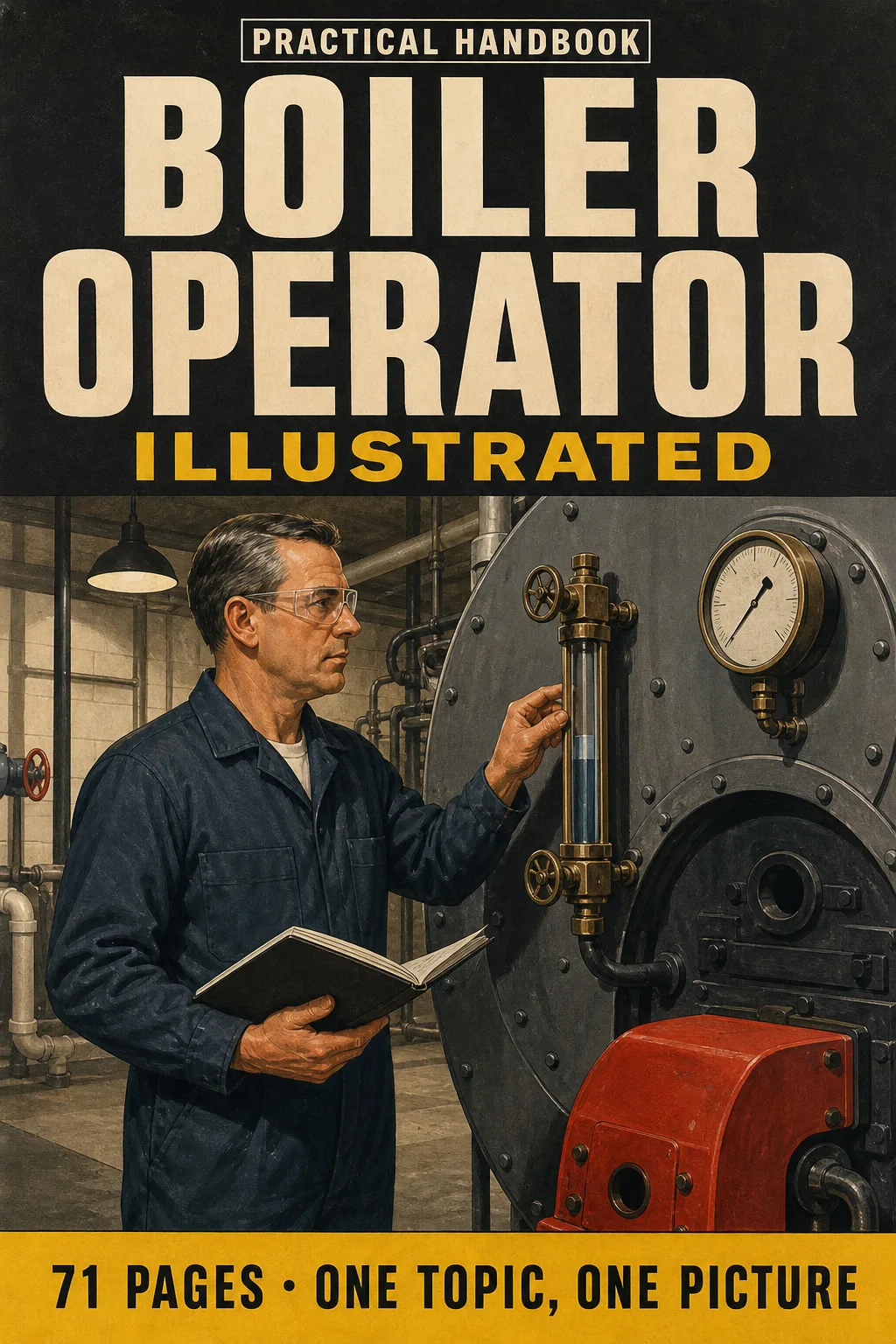
For U.S. boiler operator license exams, low and high pressure. The gauge glass, safety valves, the low-water cutoff test, combustion, bottom blowdown and BTU math: one topic per page, the drawing first, then what you need to remember. PDF by email, ready to print. 71 illustrated pages.

GET BOILER OPERATOR ILLUSTRATED

🔒 Secure checkout · PDF by email · 30-day guarantee

Every topic, its own pageEvery fitting and every test drawn, with the explanation right beside it
71 illustrated pages8 parts, from the boiler as one loop to the most common exam mistakes
Up-to-date sourcesASME Sections I and IV, ASME CSD-1, NFPA 85 and the NBIC
PDF by emailFormat

Look Inside the Book

Every page has one big drawing and a box with the numbers, limits and steps you need to know:

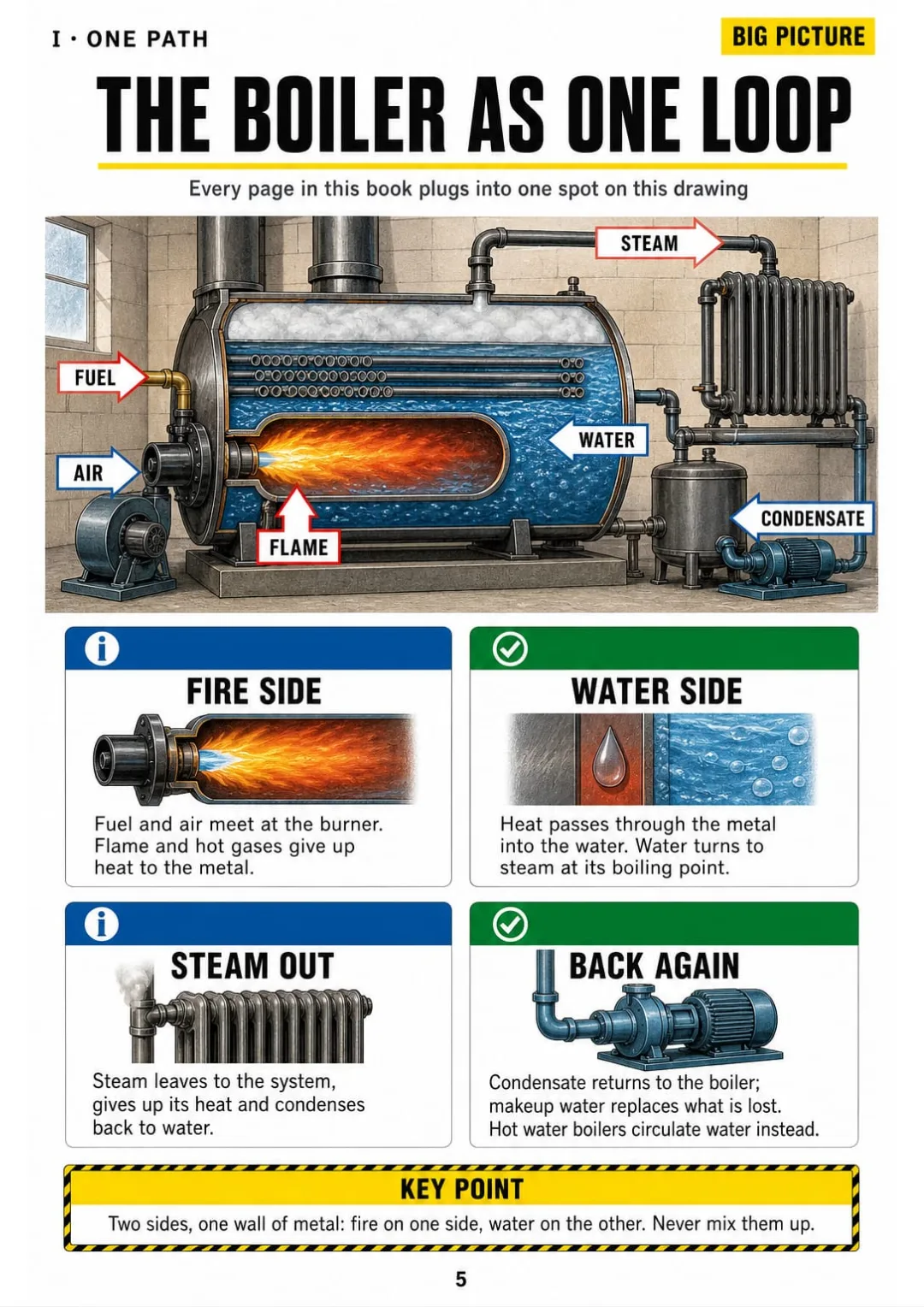
Fuel + air → flame → metal → water → steam → condensate: the boiler as one loop
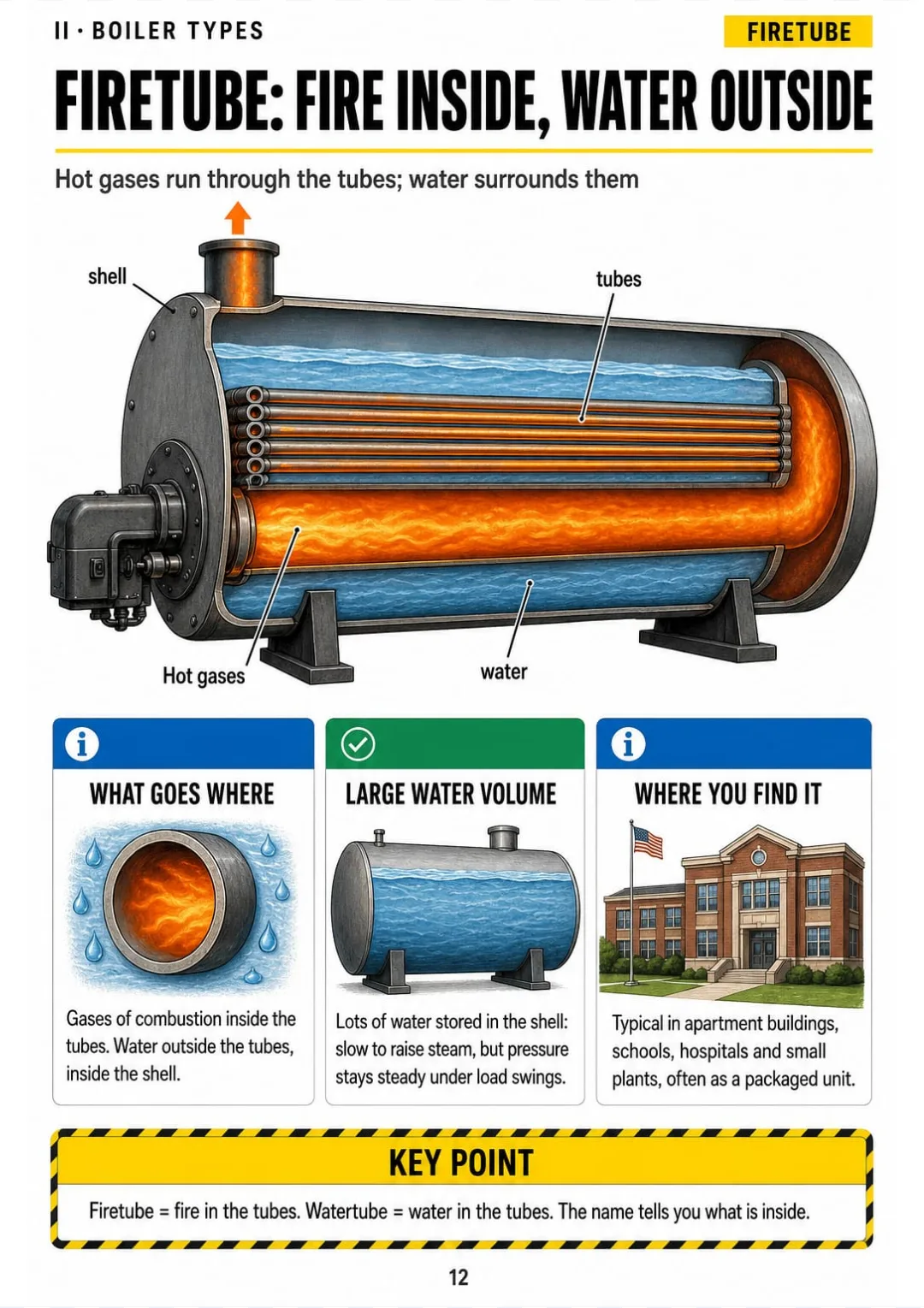
Firetube boiler: gases inside the tubes, water outside, large water volume and steady pressure.
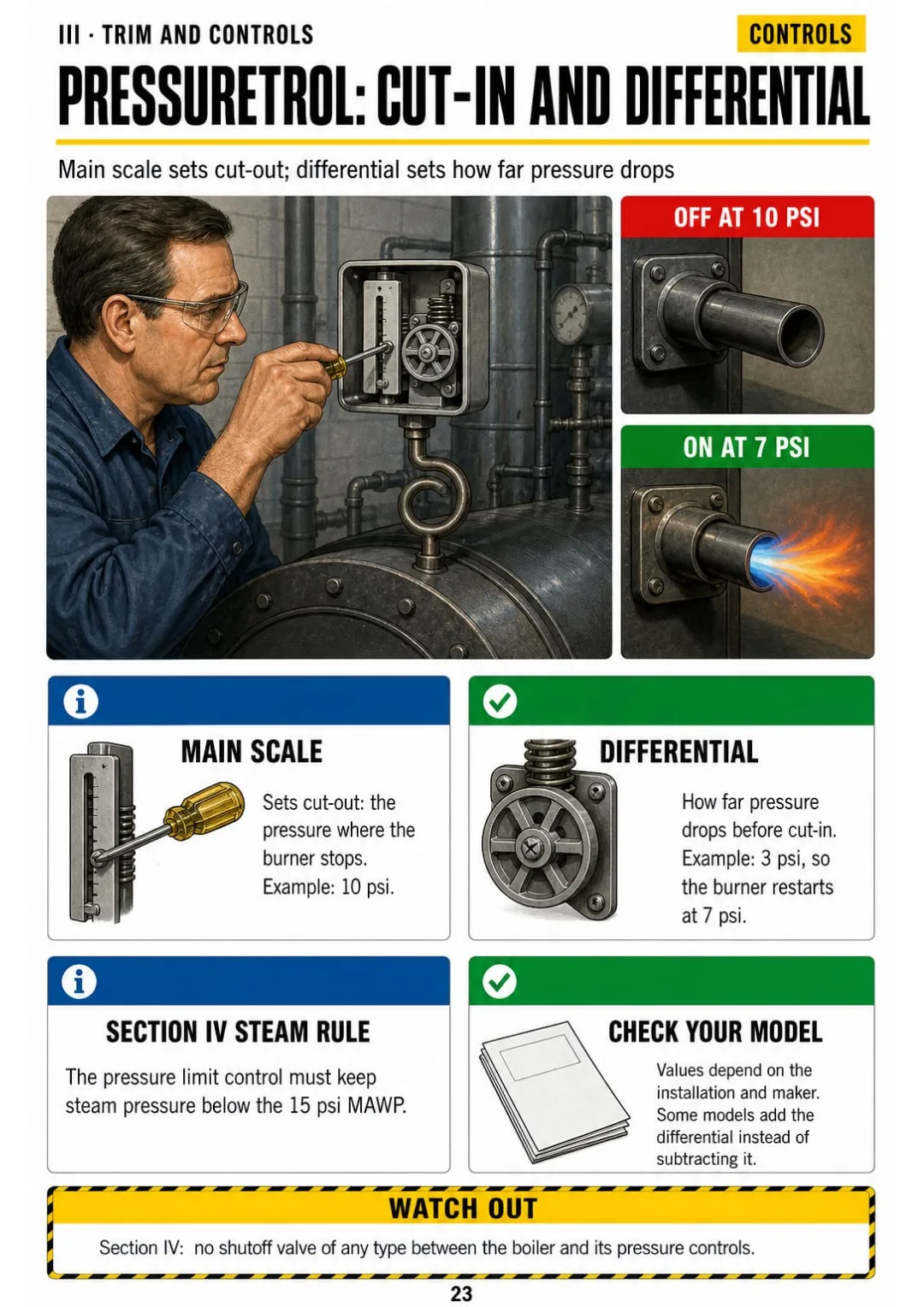
Example: main scale 10 psi, differential 3 psi → burner off at 10, on at 7.
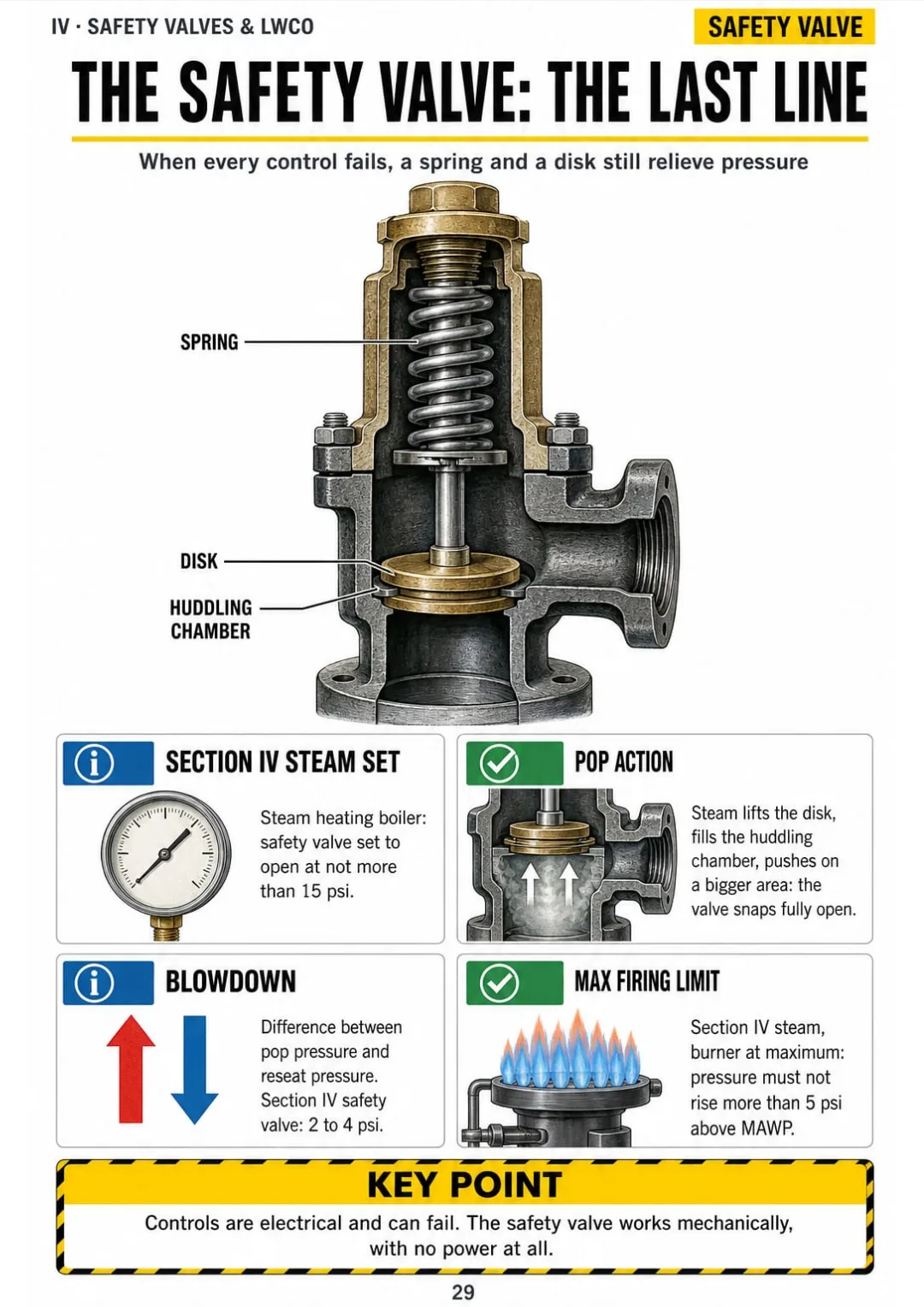
Section IV steam: set at 15 psi max, blowdown 2-4 psi, no more than 5 psi over MAWP
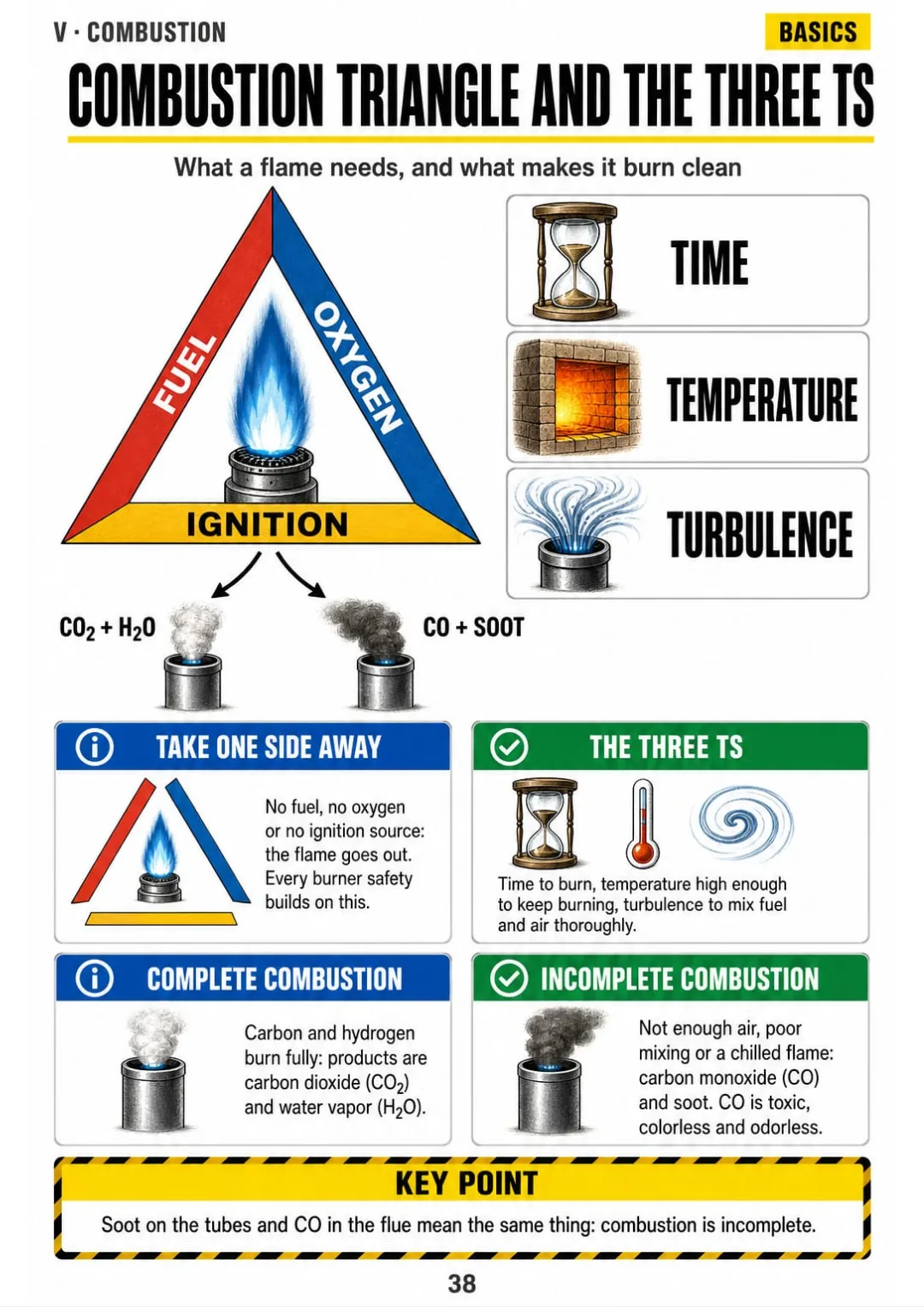
Complete combustion makes CO2 + H2O; incomplete makes CO and soot.
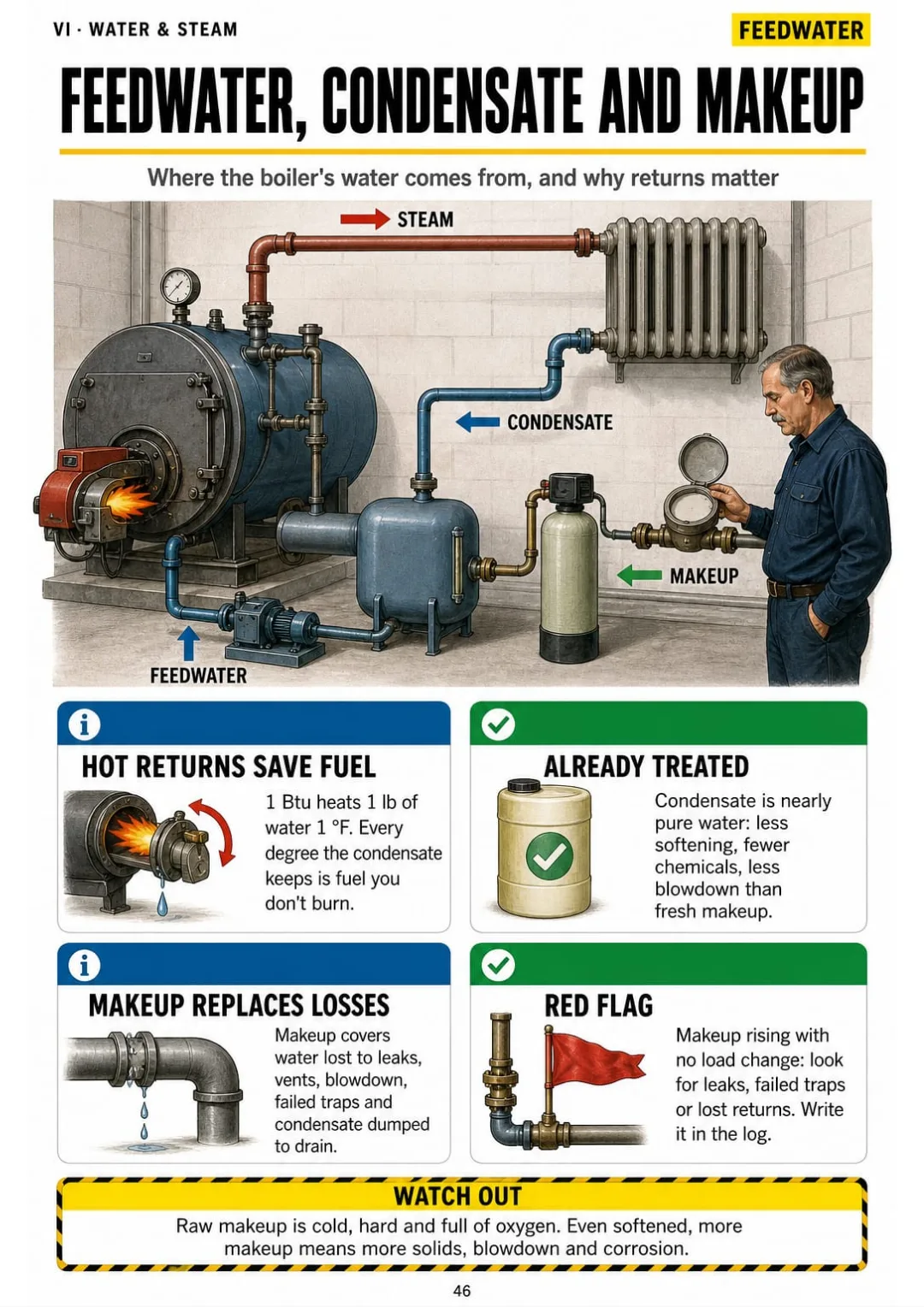
Steam out, condensate back, makeup fills the gap: the boiler water loop on one page.
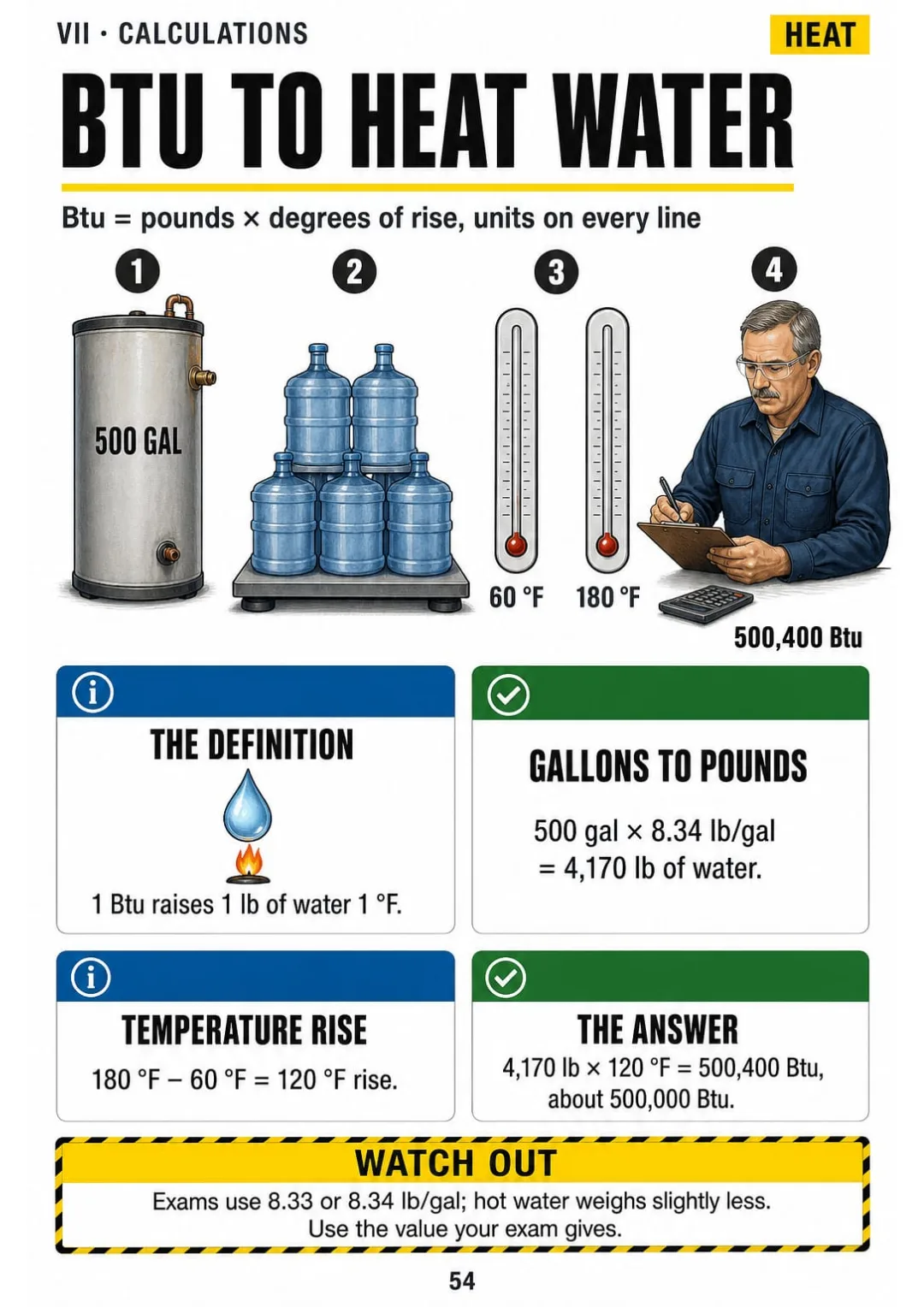
500 gallons from 60 °F to 180 °F = about 500,000 Btu, worked line by line
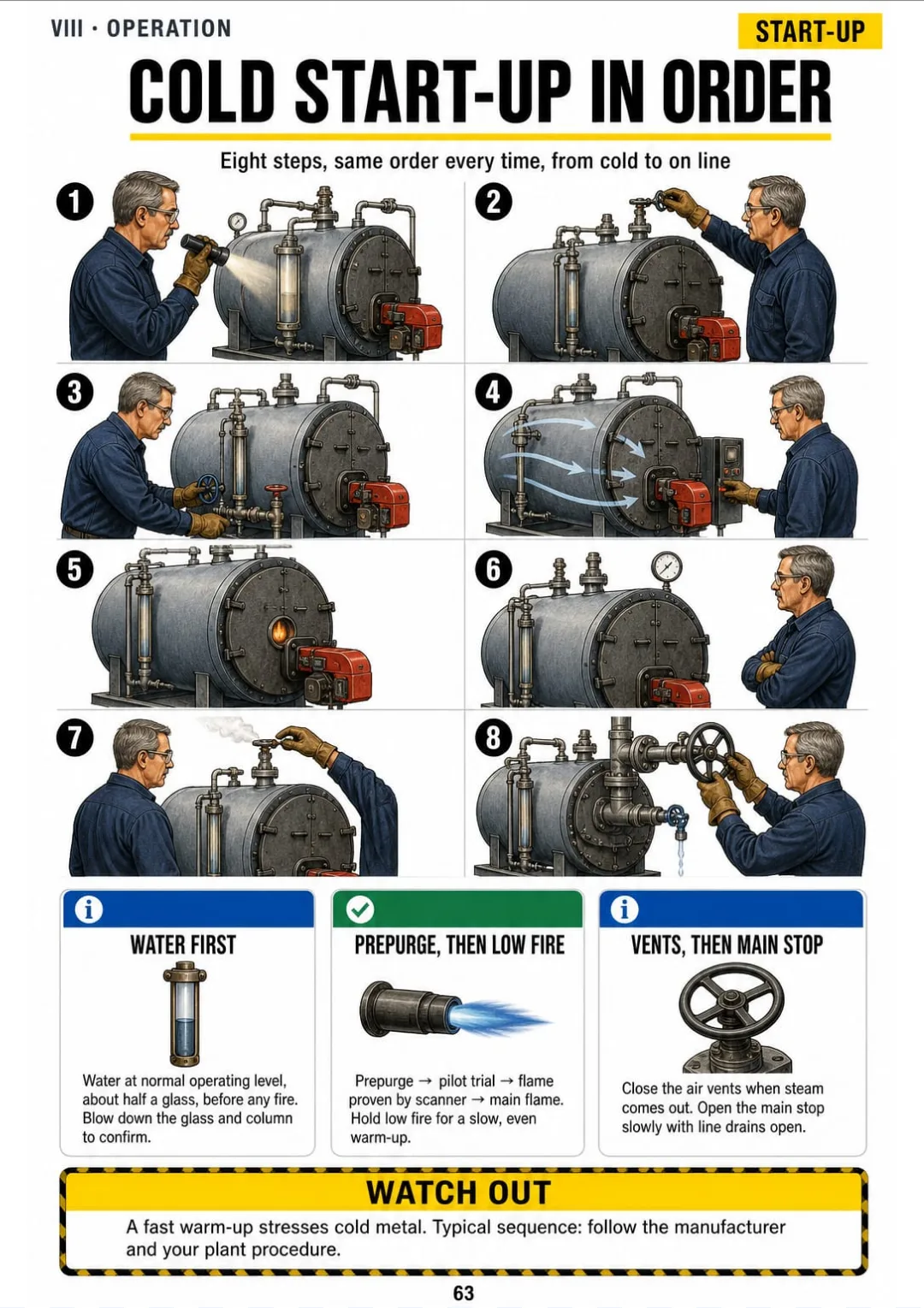
Water level → vents → valves → prepurge → low fire → warm-up → vents closed → main stop open slowly.

Swipe to see more →

These are real pages from the book. The table of contents is the full one: 8 parts and 67 topics.

The Problem Isn't You. It's How It Was Explained to You.

You're standing at the water column. The inspector taps the gauge glass and asks: where's the lowest permissible water level, and what do the try cocks tell you if the glass is wrong?

You've done this by hand a thousand times. But the study guide gives it three paragraphs of connections and fittings, and nothing on the page shows where the glass sits against the water level.

Example: main scale 10 psi, differential 3 psi → burner off at 10, on at 7.

In the book, the water column is one drawing: the column, the gauge glass, the three try cocks from top to bottom, and on a low pressure boiler, the lowest visible part of the glass at least 1 in. above the lowest permissible water level (ASME Section IV).

Same with the safety valve, the low-water cutoff test, the combustion triangle, bottom blowdown and the cold start-up: each one has its own page.

You see it, you get it, and you answer right there at the column, without going back to the manual.

COMPARE FOR YOURSELF

Same Topic, Two Ways to Study It

THIS
  • The manual: line after line of text
  • Boiler types explained in words only
  • You walk into the exam with doubts
In the firetube boiler, the products of combustion pass through tubes which are surrounded by the water contained within the shell, such that heat is transferred from the gases through the tube walls to the water by conduction and convection. Owing to the comparatively large volume of water held within the shell, the firetube design affords considerable heat storage, which tends to maintain steady pressure under fluctuating loads, although this same characteristic results in longer warm-up periods and limits the pressures and capacities to which such units are customarily applied.
FOR THIS
  • The firetube boiler in one drawing
  • The key facts in one box
  • You see it and you get it
Firetube boiler: gases inside the tubes, water outside, large water volume and steady pressure.
CONTENTS

Take a Look at the 8 Parts and 67 Topics

The boiler as one path, boiler types, trim and controls, safety valves and the low-water cutoff, combustion and burners, water and blowdown, worked calculations, and operation and emergencies: 71 pages, all illustrated.

IThe Boiler as One Path · pp. 5-11
  1. Fuel + Air → Flame → Water → Steam → Condensate
  2. Low Pressure vs High Pressure: Where the Line Is
  3. psig, psia and Inches of Mercury
  4. Heat That Raises Temperature vs Heat That Makes Steam
  5. Pressure Raises the Boiling Point
  6. Saturated, Wet and Superheated Steam
  7. Heating Surface and Where Heat Transfers
IIBoiler Types · pp. 12-19
  1. Firetube: Fire Inside, Water Outside
  2. Scotch Marine and the Pass Count
  3. HRT, Firebox and Vertical Firetube
  4. Watertube: Water Inside, Fire Outside
  5. D, A and O Type Watertube Boilers
  6. Cast Iron Sectional Boilers
  7. Hot Water Boilers and the Closed Loop
  8. Nameplate and Code Stamps
IIITrim and Controls · pp. 20-28
  1. The Water Column, Gauge Glass and Try Cocks
  2. Blowing Down the Gauge Glass in Order
  3. The Pressure Gauge and Its Siphon
  4. Pressuretrol: Operating Limit, Cut-In and Differential
  5. High Limit with Manual Reset
  6. Hot Water Controls: Aquastat and the Tridicator
  7. Feedwater Line: Valves in the Right Order
  8. Main Steam Stop Valve and Non-Return Valve
  9. Flame Safeguard and Scanners
IVSafety Valves and Low-Water Cutoff · pp. 29-37
  1. Why the Safety Valve Is the Last Line
  2. Safety Valve vs Relief Valve vs Safety-Relief
  3. Capacity: How Much the Valve Must Dump
  4. Installation Rules for the Safety Valve
  5. Testing the Safety Valve: Try Lever and Pop Test
  6. Low-Water Cutoff: Float Type vs Probe Type
  7. The Low-Water Cutoff Test, Step by Step
  8. Slow-Drain (Evaporation) Test
  9. Auxiliary Cutoff and Pump Control
VCombustion and Burners · pp. 38-45
  1. The Combustion Triangle and the Three Ts
  2. Excess Air: Too Little vs Too Much
  3. Reading a Flue Gas Analysis
  4. Natural Gas Train in Order
  5. Fuel Oil: No. 2 vs No. 6
  6. The Firing Sequence: Prepurge to Main Flame
  7. Draft: Natural, Forced, Induced, Balanced
  8. Flame Failure and Lockout
VIWater, Steam and Blowdown · pp. 46-53
  1. Feedwater, Condensate and Makeup
  2. Condensate Tank, Feed Pumps and the Deaerator
  3. Steam Traps: Four Types
  4. Scale, Corrosion and Carryover
  5. Water Treatment: What You Test and Why
  6. Surface Blowdown vs Bottom Blowdown
  7. Bottom Blowdown in the Right Order
  8. Priming, Foaming and Water Hammer
VIICalculations, Worked Step by Step · pp. 54-62
  1. BTU to Heat Water
  2. Boiler Horsepower
  3. Reading the Steam Table
  4. Pressure from a Column of Water
  5. Total Force on a Surface
  6. Firing Rate and Fuel Use
  7. Combustion Efficiency and Stack Loss
  8. Blowdown Rate
  9. Safety Valve Capacity Check
VIIIOperation, Emergencies and Review · pp. 63-71
  1. Cold Start-Up in Order
  2. Shutdown and Cut-In on a Header
  3. Emergency: Low Water
  4. Emergency: Overpressure, Tube Leak, Flame Failure
  5. Daily, Weekly, Monthly, Annual Checks
  6. The Boiler Log and the Inspector's Visit
  7. Lay-Up: Wet vs Dry
  8. Hydrostatic Test and Internal Inspection Prep
  9. The Most Common Mistakes on the Exam

One Page, One Topic, All Clear

Think of it this way:

It's Monday morning, the boiler's been off all weekend and you have to bring it up cold. The order matters, and nobody's standing next to you.

You open the cold start-up page and see it drawn in order: water level, vents, valves, prepurge, low fire, warm-up, vents closed, main stop opened slowly.

Complete combustion makes CO2 + H2O; incomplete makes CO and soot.

Same with blowing down the gauge glass, the safety valve test, the low-water cutoff test, bottom blowdown and boiler horsepower: each one on its own page.

Boiler Operator Illustrated is 8 parts and 67 topics, all drawn, with the calculations worked step by step and a final page on the most common exam mistakes.

What you see drawn, you don't have to memorize.

What's Inside Boiler Operator Illustrated:

Ipp. 5-11

The Boiler as One Path

The boiler as one loop from fuel to condensate, where low pressure ends and high pressure starts, psig vs psia, sensible vs latent heat, and the types of steam.

IIpp. 12-19

Boiler Types

Firetube and watertube side by side, Scotch marine passes, HRT and firebox, D, A and O types, cast iron sectionals, hot water loops and the nameplate.

IIIpp. 20-28

Trim and Controls

The water column, gauge glass and try cocks, the pressure gauge and siphon, the pressuretrol and high limit, hot water controls, the feedwater line and flame safeguards.

IVpp. 29-37

Safety Valves and Low-Water Cutoff

Why the safety valve is the last line of defense, the valve types, capacity, installation and testing, plus float vs probe cutoffs and the low-water cutoff test step by step, so you can walk through it in front of the inspector.

Vpp. 38-45

Combustion and Burners

The combustion triangle and the three Ts, excess air, flue gas analysis, the gas train, No. 2 vs No. 6 oil, the firing sequence, draft and lockout.

VIpp. 46-53

Water, Steam and Blowdown

Feedwater, condensate and makeup, the deaerator, four steam trap types, scale and corrosion, water treatment, surface vs bottom blowdown, priming and water hammer.

VIIpp. 54-62

Calculations, Worked Step by Step

BTU to heat water, boiler horsepower, the steam table, pressure from a water column, total force, fuel use, stack loss, blowdown rate and safety valve capacity, each worked line by line so you see where every number comes from.

VIIIpp. 63-71

Operation, Emergencies and Review

Cold start-up, shutdown and cut-in, low water and other emergencies, daily to annual checks, the log and the inspector's visit, lay-up, the hydro test and the most common exam mistakes.

At the end of the book: Worked BTU, boiler horsepower and blowdown calculations, plus a page on the most common exam mistakes.
Plus: 2 Free Books

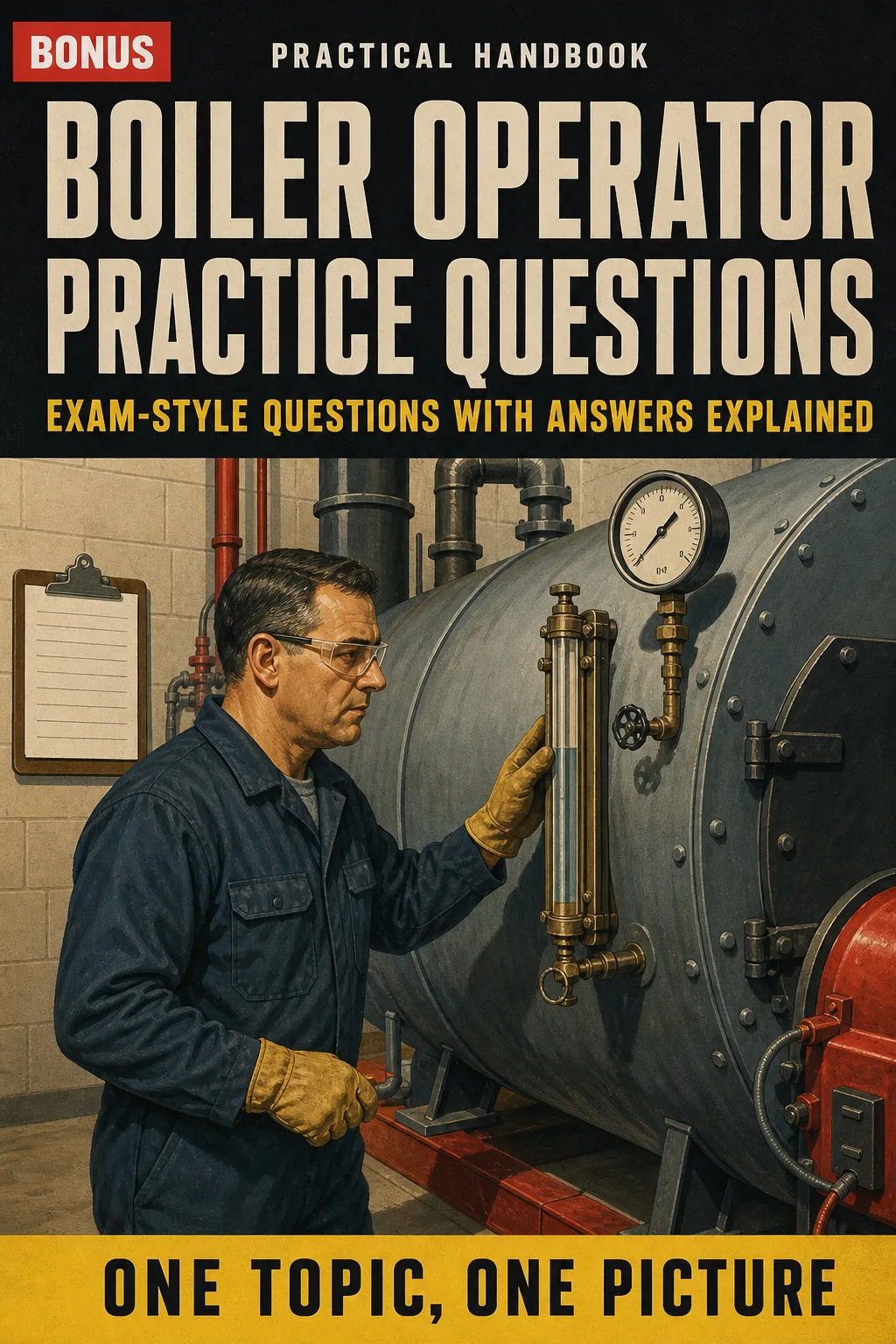
Boiler Operator Practice Questions: Exam-Style Questions with Answers Explained

BONUS 1: «Boiler Operator Practice Questions: Exam-Style Questions with Answers Explained»

Value on its own: US$ 17.90

Practice the way the exam asks: multiple-choice questions on trim, safety valves, combustion and calculations, each answer explained with a page reference.

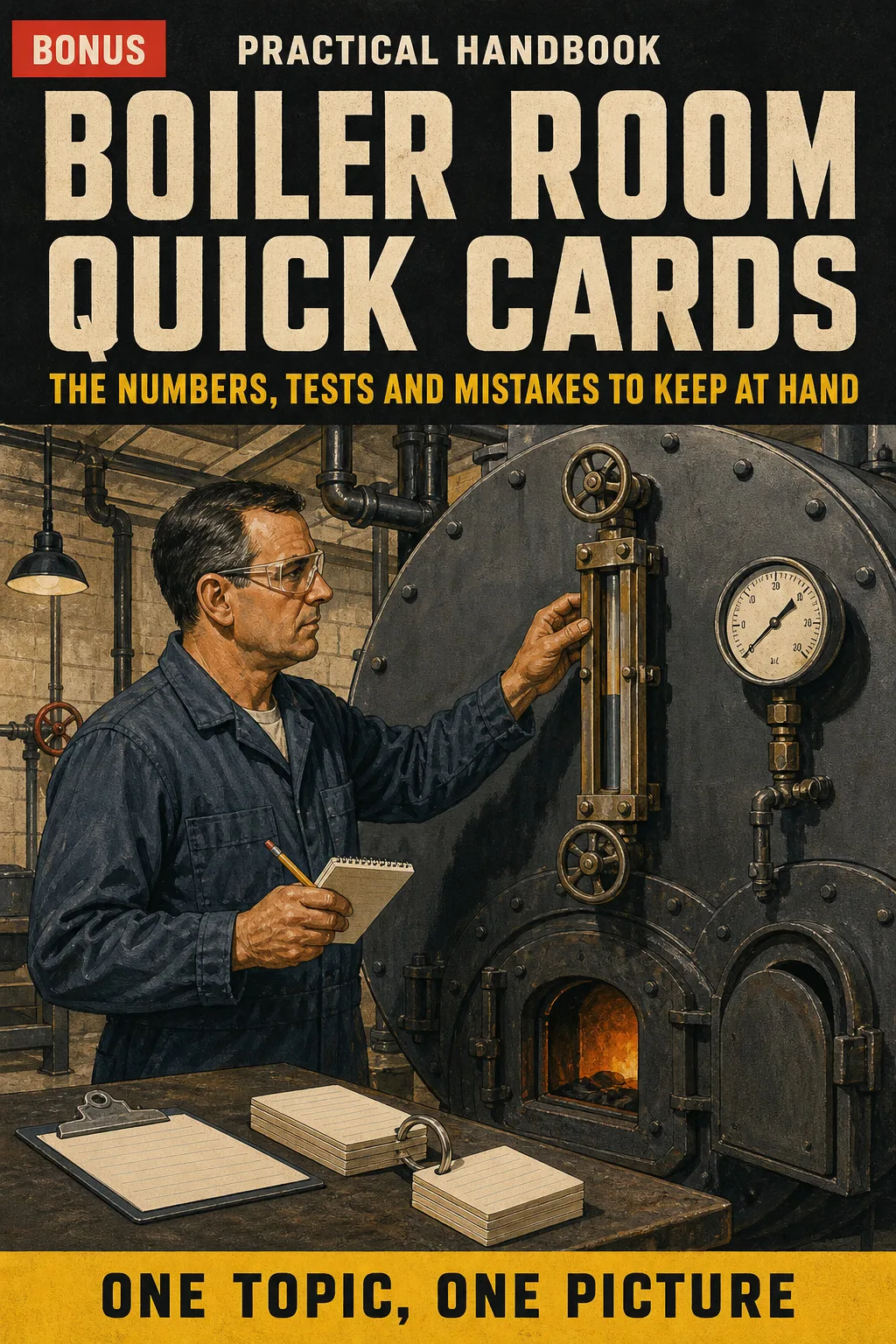
Boiler Room Quick Cards: The Numbers, Tests and Mistakes to Keep at Hand

BONUS 2: «Boiler Room Quick Cards: The Numbers, Tests and Mistakes to Keep at Hand»

Value on its own: US$ 14.90

Review in five minutes before a shift or the exam: the key numbers, the daily test sequences and the most common mistakes, one printable card each.

Boiler Operator Illustrated with 2 Free Books

  • Boiler Operator Illustrated: 71 illustrated pagesUS$ 63
  • BONUS 1: Boiler Operator Practice Questions: Exam-Style Questions with Answers ExplainedUS$ 17.90
  • BONUS 2: Boiler Room Quick Cards: The Numbers, Tests and Mistakes to Keep at HandUS$ 14.90
  • High-resolution PDF to printIncluded
Total value US$ 95.80
YOUR PRICE:
US$ 27
You save US$ 68.80
YES, I WANT BOILER OPERATOR ILLUSTRATED FOR US$ 27

📄 This is a digital PDF book sent to your email: nothing is printed or shipped.

Secure purchaseEncrypted payment30-day guarantee

PDF by email: We email you Boiler Operator Illustrated as a PDF, together with the two free books. It's a single payment: no installments, no extra charges.

Who This Book Is For

You're studying for your license

You're studying for your license

You follow the boiler as one loop, then every fitting and every test on its own page, so the guide finally fits together.

Your exam date is close

Your exam date is close

You review the numbers, the test sequences and the worked BTU and horsepower problems in the same order, page by page.

You already run the boiler room

You already run the boiler room

You print the pages you need and keep the low-water cutoff test, blowdown and start-up at hand for the next inspection.

Everything You Get Today

US$ 95.80US$ 27
YES, I WANT BOILER OPERATOR ILLUSTRATED FOR US$ 27

📄 This is a digital PDF book sent to your email: nothing is printed or shipped.

30DAYS
GUARANTEE

30-Day Guarantee

Try Boiler Operator Illustrated for 30 days, bonus books included.

We refund everything if the file won't open, if the book isn't what you see here, if you were charged twice or if the email doesn't arrive. Just email us.

You pay once. No subscriptions.

Frequently Asked Questions

Is it for me if I've run boilers for years but never taken the written exam?

Yes. It explains what you already do with your hands, one drawing per topic, and adds what the written exam asks about: low pressure (Section IV) and high pressure (Section I), watertube D, A and O types, the deaerator, No. 6 oil, the steam table, and BTU, boiler horsepower and safety valve capacity worked step by step.

Does it work for my exam: New Jersey Black Seal, NYC, Chicago or another state?

It's built on ASME Sections I, IV and VI, ASME CSD-1, NFPA 85 and the National Board Inspection Code. Code editions change and every state or city sets its own license rules, so check each limit against the current edition and your licensing board (New Jersey, NYC, Chicago or your state).

Is this official material?

No. It's an independent illustrated study book. It isn't issued or endorsed by ASME, NFPA, the National Board or any licensing board.

Does it replace a course or training?

No. It's study and review material. It doesn't give you a license, a certificate or training hours, and it doesn't replace hands-on training, the manufacturer's manual or the rules of your jurisdiction.

Are the practice questions the ones on the exam?

No. They're written for this book in the style of the exam, and each answer is explained with a page reference.

When and how do I get it?

As a PDF by email, sent to the address you enter at checkout. The two bonus books come the same way.

Do I have to pay every month?

No. It's a one-time payment, with no subscription.

Can I have it on paper?

Yes. The PDF is ready to print, so you can keep the pages you need in the boiler room.

How does the refund work?

You have 30 days. We refund everything if the file won't open, if the book isn't what you see on this page, if you were charged twice or if the email doesn't arrive: just email us.

Before You Close This Page

No more rereading with nothing sticking.

The water column and the safety valve: you see them drawn and you've got it.

You walk into the exam and the boiler room knowing where everything is.

Drawings make studying faster.

The book is right below.

One-time payment: US$ 27 · Guarantee: 30 days · PDF by email

YES, I WANT BOILER OPERATOR ILLUSTRATED FOR US$ 27

📄 This is a digital PDF book sent to your email: nothing is printed or shipped.